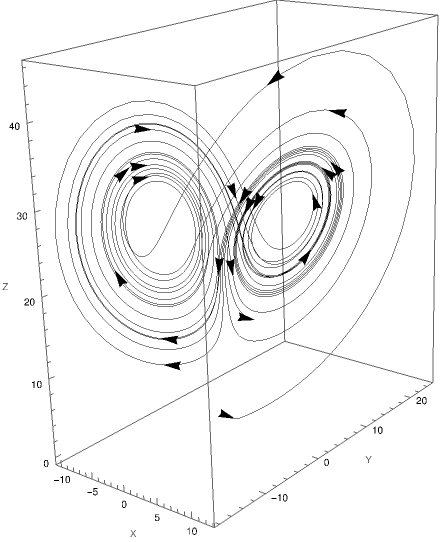
OK, I would like (to try) to answer the question you asked in this post about a possible implementation of the Euler method in Mathematica. But I think to give an answer here is more appropriate.
To have an example at hand I use the famous Lorenz system. The core of the idea is to do the iteration with NestList[]: say, you want to iterate a function func three times, starting with x0, then you can do it like so:
NestList[func, x0, 3]
(*  Out:  {x0,func[x0],func[func[x0]],func[func[func[x0]]]}   *)
Now for the Euler method on the Lorenz system - here is my approach:
(* function describing v' at time t  -  here Lorenz system: *)
f[{t_, v : {x_, y_, z_}}] := {t, {-3 (x - y), -x z + 26.5 x - y, x y - z}}
(* step size - to be adjusted: *)
h = 0.02;
(* single step of iteration - general formulation: *)
eulerStep[{t_, v_List}] := {t + h, v + h/2 (f[{t, v}][[2]] + f[{t + h, v + h f[{t, v}][[2]]}][[2]])}
(* initial conditions: *)
init = {0, {0, 1, 0}};
(* performing iteration (here 2000 steps): *)
data = NestList[eulerStep, init, 2000];
pts = Last /@ data;
Graphics3D[{Arrowheads[{.03, #} & /@ Range[0, 1, .05]], Arrow[pts]},
 Axes -> True, BoxRatios -> Automatic, AxesLabel -> {"X", "Y", "Z"}]

This reminds me of a washing machine, but in fact it is the well known Lorenz attactor.
Does that help? Regards – Henrik
[1]: Improved Eulers Method Problem
[2]: https://community.wolfram.com//c/portal/getImageAttachment?filename=Lorenz.png&userId=32203